
Use Cases
Applied Intelligence in Practice
We believe that value is derived at the intesection of human expertise and automation. Human expertise is the most valuable asset of an organization, and it can be amplified with machine intelligence and automation. Operational efficiency requires reducing friction across business processes and removing redundant manual steps.
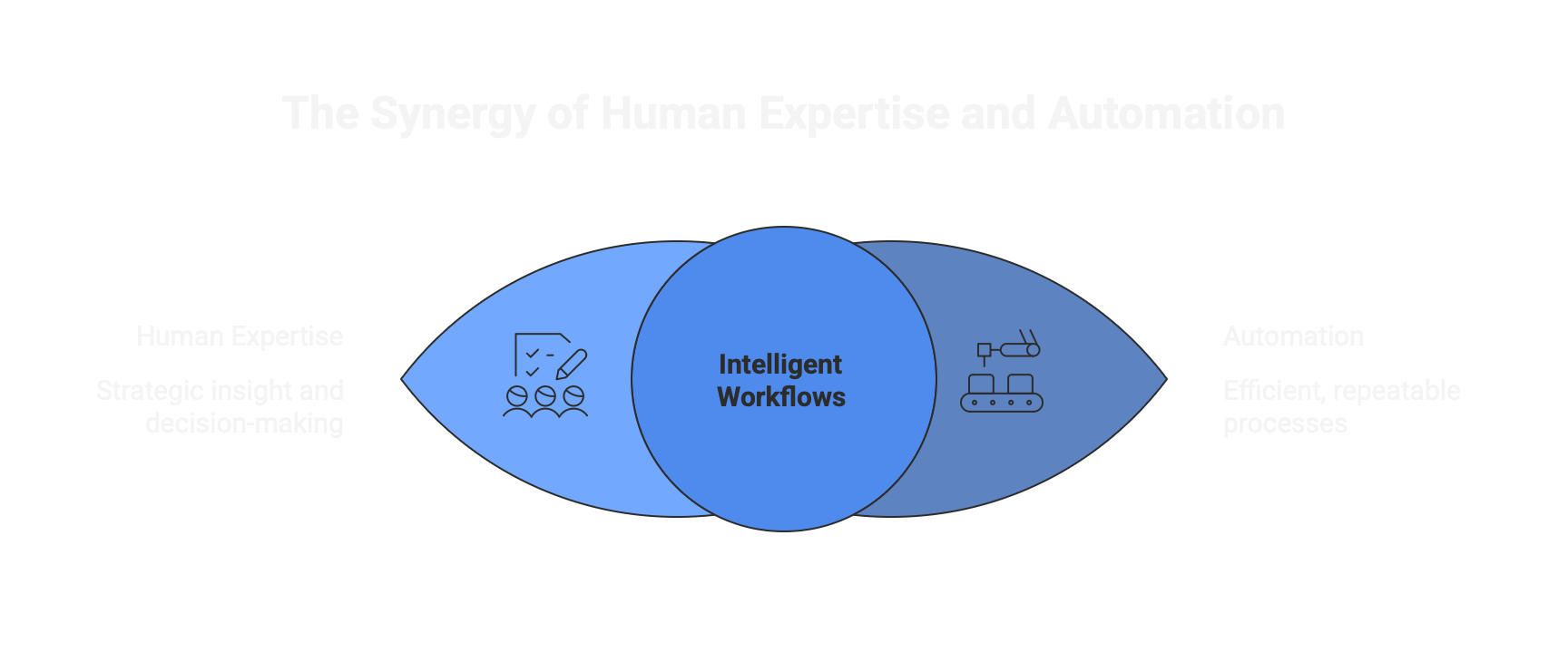
Driving intelligent automation with with human expertise succeeds when it is tied to real business drivers and measurable operational improvements. If there are tideous tasks wrapped around business processes, it invariably slows down your business operations. This can be transformed with intelligent workflows.
The following use cases reflect how organizations typically engage—progressing from foundational readiness to integrated intelligence maturity.
AI Operations Readiness
Prepare operations for intelligence
Align business logic, workflows, and data structures so intelligent systems can operate safely and effectively.
- Clarify process ownership and eliminate ambiguity
- Improve data accessibility and retrieval pathways
- Establish policy boundaries and control mechanisms
- Identify high-impact, low-risk AI entry points
Automation
Reduce friction across workflows
Streamline execution pathways, shorten cycle times, and create the structural consistency necessary for scalable intelligence deployment.
- Reduce manual bottlenecks
- Standardize recurring processes
- Improve decision latency to yield predictable and consistent outcomes
- Increase operational throughput
AI Deploy
Introduce intelligence deliberately
Deploy scoped, governed implementations tied to defined business processes with bounded execution and observability.
- Introduce specialist agents aligned to defined workflows
- Integrate intelligent systems into existing infrastructure
- Maintain bounded execution and observability
- Align deployment with governance requirements
AI Measure
Measure operational impact
Evaluate deployments based on business outcomes rather than technical novelty and use evidence to guide expansion.
- Define performance metrics tied to business drivers
- Measure cycle time reduction, cost efficiency, or output quality
- Establish feedback loops for refinement
- Inform expansion decisions with data
Intelligence Fusion Center (Mature State)
The Intelligence Fusion Center represents a mature operating model where cross-functional collaboration, unified data flows, and intelligent systems converge to support strategic decision-making.
It is not a single deployment, but the outcome of deliberate top-down process evaluation, refinement, redundancy removal, and alignment of technology with business objectives.
- Data flows are coordinated across functions
- Automation and intelligence operate cohesively
- Decision cycles are accelerated through governed systems
- Business drivers and technology are aligned
Maturity Progression
Digitalization — AI Readiness — Automation — AI Deploy — AI Measure — Intelligence Fusion Center
Begin with Digitalization. Build the foundation that makes AI effective and accountable.